

A one carat visual equivalent moissanite stone typically runs $50 to $800 loose, with finished rings landing in the low hundreds to under $1,000 once metal and setting are added. Buy it for the sparkle and the ethics, not as an investment. Merijaan’s lab-grown moissanite pieces sit squarely in that honest price range, making them worth a look before you shop anywhere else.
TL;DR:
- The price of a one-carat visual equivalent moissanite ranges from $50 to $800 for loose stones and from low hundreds to under $1,000 for finished rings, depending on quality and brand.
- Larger moissanite stones offer better value because price-per-visual-carat rises more slowly compared to diamonds, making 1.5 carats or more more affordable for a bigger look.
- The main cost factors are stone size and cut quality, with branded, precision-cut stones significantly more expensive than generic options, while setting material impacts total price as well.
- Buyers should request exact millimeter dimensions and high-quality photos to verify cut and size, avoiding listings with vague terminology or no clear return and warranty policies.
- Moissanite is a preferable alternative to diamonds for affordable sparkle, especially when bought from reputable sellers who prioritize transparency, quality, and ethical sourcing.
Table of Contents
- What Drives a Labordiamant Preis (Lab Diamond Price) for Moissanite
- What Actually Changes the Price Tag
- How to Budget for Moissanite Without Overpaying
- Why We Recommend Moissanite Over Chasing a Diamond Substitute
- See the Pricing for Yourself
- Sources
What Drives a Labordiamant Preis (Lab Diamond Price) for Moissanite
Loose moissanite pricing follows a fairly predictable curve, and it’s a lot gentler than what you’ll find with mined or lab-grown diamonds. A 0.5 ct equivalent stone often starts under $50, while a 3.0 ct equivalent can run several hundred dollars depending on the cut house behind it. Generic factory stones sit at the bottom of every bracket. Precision-cut branded stones sit at the top.
Price Snapshot: A 1 ct equivalent loose moissanite typically costs $50 to $800, and a well-made finished ring at that same visual size commonly falls in the low hundreds to under $1,000.
That’s a wide range for one stone size, and the spread comes down to what you’re actually paying for beyond the gem itself. Finished jewelry pricing stacks three things on top of the stone: the metal, the labor to set it, and the retailer’s margin. A sterling silver setting adds far less than a solid gold band. Intricate prong work or a halo design adds more labor cost than a simple bezel.
Here’s how that plays out in two real-world scenarios at the same visual carat size:
- Budget build: A 1 ct equivalent stone in a simple sterling silver solitaire setting, landing near the lower end of that finished-ring range.
- Premium build: The same visual size stone, precision cut by a known brand, set in a heavier gold band with detailed metalwork, pushing toward the top of the range or slightly beyond it.
Neither buyer is getting ripped off. They’re paying for different things: one for pure value, the other for craftsmanship and material weight. Where moissanite pulls ahead of mined stones is at larger sizes, as detailed in this Moissanite vs Cubic Zirconia: What to Choose for Affordable Luxury comparison. Because price-per-visual-carat rises far more slowly with moissanite than with diamond, shoppers who want a bigger look for a smaller number get noticeably more for their money once they cross the 1.5 ct equivalent mark. That’s also roughly 50 to 70% less than a comparable lab-grown diamond, which is the gap that makes moissanite the practical pick for anyone who wants the look without the price tag that comes with it.
What Actually Changes the Price Tag
Not every dollar you spend on moissanite buys the same thing. Some of it buys size, some buys craftsmanship, and some buys peace of mind. Here’s what actually moves the number on a product page:
- Visual carat equivalent. Size is the single biggest lever. Moissanite is measured by how large it looks compared to a diamond of the same visual weight, and that equivalence is why size dominates the price conversation the way it does.
- Cut precision. A branded, precision-cut stone throws more fire and catches light more evenly than a generic cut of the same size. That difference in cutting is what most of the real premium pays for, not some hidden grading scale borrowed from diamonds.
- Brand and service. A warranty, a real return window, and documented sourcing all cost the retailer money to offer, and that shows up in the price. It’s a fair trade for not gambling on a stranger’s listing.
- Setting and metal. Sterling silver keeps costs down. Gold vermeil sits in the middle. Solid gold pushes the total up regardless of the stone underneath it.
- Listing obfuscation. Watch for vague terms like “premium grade” or “AAA quality” with no dimensions attached. Those phrases borrow diamond language that doesn’t really apply to moissanite, and they’re often a sign the seller wants you focused on adjectives instead of specs.
Because moissanite is grown under controlled lab conditions, color and clarity barely vary from stone to stone. The real differentiator is cut and finishing quality, not a 4Cs style hierarchy borrowed from mined diamonds. If a listing leans hard on grading talk instead of showing you a close-up photo and exact millimeter dimensions, that’s worth noticing.
Pro Tip: Ask any seller for the stone’s exact millimeter dimensions before you buy, not just the “carat equivalent.” Two stones can share the same equivalent weight and look noticeably different in person depending on how they’re cut.
Setting choice matters here too. A gem’s shape changes how it reads on the hand and how much labor goes into setting it securely, which is part of why an oval solitaire and a cushion-cut halo at the same carat size rarely cost the same.
How to Budget for Moissanite Without Overpaying
Set your budget around the setting you want first, then let the stone size follow. Three realistic starting points:
- Low budget (roughly $150 to $300): A modest visual carat equivalent in sterling silver, simple prong or bezel setting.
- Mid budget (roughly $300 to $600): A 1 ct to 1.5 ct equivalent, precision-cut stone, gold vermeil or a lighter gold band.
- Premium budget ($600 to under $1,000): A larger visual equivalent or a branded precision cut, set in solid gold with detailed metalwork.
Before you commit to any listing, run it through a short checklist:
- Exact stone dimensions in millimeters, not just a carat equivalent
- Close-up, well-lit photos that show the actual cut and facets
- A stated return policy with a real window, not “final sale”
- A warranty or exchange option in case a prong bends or a stone loosens
- Clear language about where and how the stone was sourced
Reality Check: Sellers who publish exact dimensions, offer high-resolution photos with visible scale, and back the sale with warranties or returns are consistently the safer bet for a first-time online moissanite purchase.
Red flags run in the opposite direction: vague specs, no return policy, a price that’s suspiciously lower than everything else at the same size, or photos that look inconsistent from one angle to the next. Any one of those alone might be nothing. Two or three together are a reason to keep shopping. Run a Merijaan listing through the same checklist. You’ll find exact dimensions, real photos, and a stated return policy every time, which is the whole point of the exercise.
Why We Recommend Moissanite Over Chasing a Diamond Substitute
Merijaan built its entire catalog around lab-grown moissanite for a simple reason: it delivers real sparkle at a price point that doesn’t require pretending you’re buying an investment asset. Pieces like the Vaduz Ring, the Einsiedeln Bracelet, and the Frauenfeld Necklace exist to prove that a well-cut stone in a thoughtful setting can hold its own without a four-figure price tag attached.
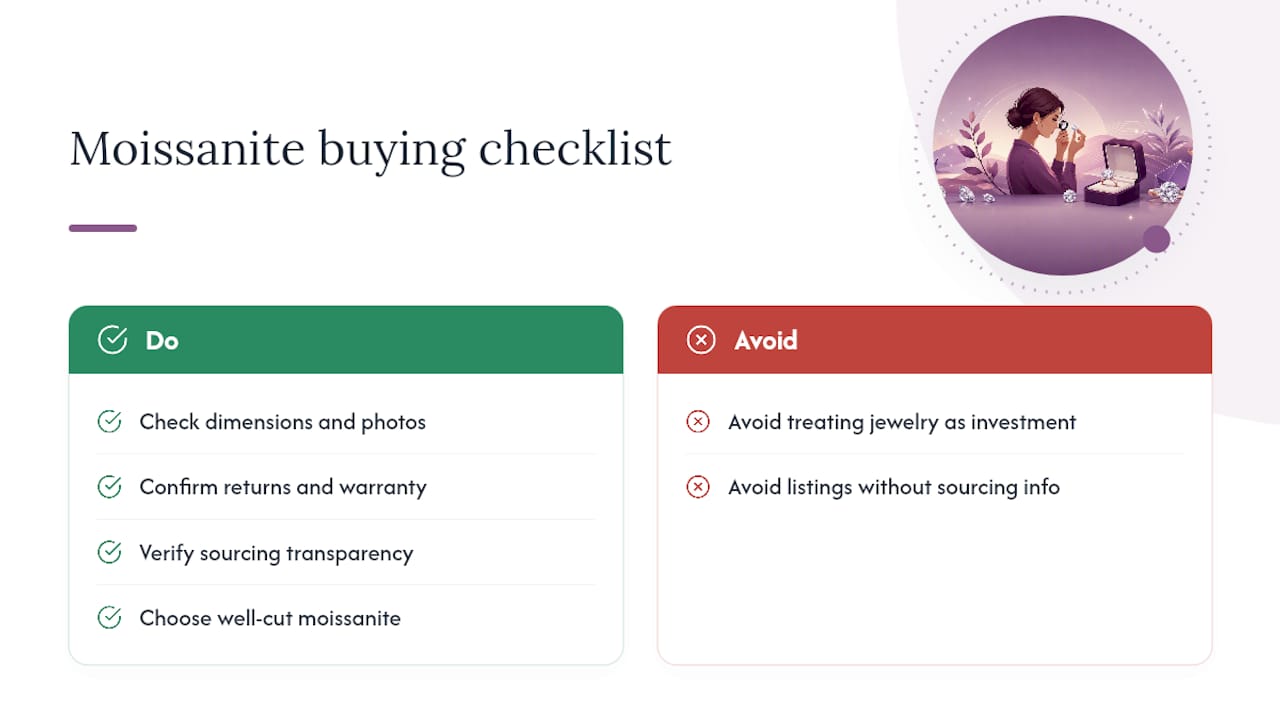
The ethics side isn’t an afterthought either. That kind of transparency around sourcing is exactly what the buying checklist above is designed to test for.
Run any Merijaan listing against those five checklist points: dimensions, photos, returns, warranty, sourcing. It holds up on all five, which is more than most listings in this price range can say.
— Ammar
See the Pricing for Yourself
Everything in this guide points to the same conclusion: pay for cut quality, honest sizing, and a seller who stands behind the piece, not for grading language borrowed from diamonds. Merijaan’s rings, bracelets, and necklaces are priced exactly where this guide says they should be, with the sourcing details laid out plainly instead of buried in fine print.
Start by checking the exact stone dimensions on a piece like the Frauenfeld Necklace, then compare it against the checklist from this article. If you want the full picture on where the stones come from and how the brand sources them, the sourcing policy spells it out in plain language. Have a custom sizing question or want a stone swapped into a different setting? Reach out before you buy. Getting the fit right the first time beats returning a piece later.
Sources
- Moissanite Price Guide: Value and Cost in 2026
- Moissanite vs Diamond: Is It Worth the Savings or Will You Regret It?
- Moissanite vs Diamond: An Honest, Numerate Buyer’s Guide to Fire, Hardness, and Price — CaratWire
- Simulants, Moissanite and Lab-Grown Diamonds | GIA 4Cs

