

Moissanite comes in far more than the classic clear sparkle: colorless and near-colorless stones dominate the market, but champagne, green, blue, gray, black, and even pink or “aurora” versions exist too. The catch is that many of the most vivid fancy colors get their punch from a surface coating rather than the stone itself, so the real question before you buy isn’t “what color” but “is this color permanent, and does the seller say so?”
TL;DR:
- Most vivid fancy colors of moissanite, such as pink, red, and multi-hue stones, are created through surface coatings that may wear over time, unlike intrinsic colors that are permanent.
- Metal selection influences the final appearance, with warm tones like champagne thriving against yellow or rose gold, while colorless or gray stones typically look better in white gold or platinum.
- Buyers should verify whether a colored moissanite is coated or intrinsic by checking for surface wear, metallic lustre on facets, and asking sellers directly, as coatings can diminish in quality with wear.
- Intrinsically colored moissanite, especially at the top of the demand curve, maintains value better and is generally more durable than coated, vivid-colored stones.
- Purchasing from sellers transparent about treatment and with a solid return policy minimizes risks associated with coated or treated moissanite, especially for bold and saturated colors.
Table of Contents
- What Are the Different Moissanite Colors?
- Why Does Moissanite Color Vary So Much?
- Which Moissanite Color Should You Choose? A Shade-by-Shade Breakdown
- How Do You Pick the Right Moissanite Color?
- Does Color Affect a Moissanite’s Value?
- How Do You Spot a Coated or Treated Moissanite?
- How Meri Jaan Applies This Knowledge
- Is Coated Moissanite Worth the Risk?
- Ready to Choose Your Moissanite Color?
- Sources
- FAQ
What Are the Different Moissanite Colors?
Sellers group moissanite into a handful of recognizable categories, though the naming isn’t standardized across the industry the way it is with diamonds. That inconsistency trips up a lot of first-time buyers.
The broadest and most common category is colorless to near-colorless, which mimics the traditional white diamond look most people picture in an engagement ring. Below that sits a warmer band: champagne, honey, and light brown tones that read almost like a cognac diamond. Then things branch out into specialty territory.
- Colorless and near-colorless: the standard, widely stocked option across nearly every retailer.
- Champagne, yellow, and brown: warm intrinsic tones, often used for vintage-style settings.
- Green and blue: some occur intrinsically from trace elements, others are enhanced.
- Pink and red: rare in nature, almost always achieved through surface treatment.
- Gray and black: popular for men’s jewelry and edgy statement pieces.
- Aurora or multi-hue coated stones: shift color depending on the angle and light source.
Grading adds another layer of confusion. Diamonds use the universal D to Z color scale. Moissanite sellers sometimes borrow that same letter system, and other times use their own proprietary color charts entirely, according to Tianyu Gems’ moissanite color table guide. That means a “D color” moissanite from one supplier might not match a “D color” stone from another. Colorless and near-colorless stones stay widely and reliably available. Anything past champagne, especially saturated blue, pink, or multi-tone stones, tends to fall into a specialty tier that not every jeweler carries, and pricing and quality can swing a lot within that tier.
Why Does Moissanite Color Vary So Much?
Moissanite is silicon carbide, and its color has two very different origin stories: what’s baked into the crystal, and what’s painted onto the surface afterward.
Intrinsic color comes from trace elements and irregularities in how the crystal forms, called zoning. Early synthetic moissanite, going back to the late 1990s, often had a noticeable green or yellow cast because production methods weren’t refined enough to eliminate those trace elements. That’s changed. Modern near-colorless lab-grown moissanite, sometimes marketed under names like “Forever One,” reflects real advances in controlling crystal growth, according to the Gem Society’s overview of moissanite.
Surface treatments are a separate matter entirely. A thin coating, sometimes applied through a sputtering process similar to how eyeglass lenses get their anti-glare layer, sits on top of the stone and can produce vivid blues, pinks, yellows, or shifting “aurora” effects that would be extremely rare or impossible to grow naturally.
Statistic Callout: Colored moissanite has historically included intrinsic tones like brown, green, light blue, teal, and black, but the brighter blues, pinks, yellows, and reds now flooding the market are largely a product of surface coating technology, according to the Gemmological Association of Australia.
- Intrinsic color: baked into the crystal structure, generally permanent.
- Surface coating: applied afterward, cosmetic, and vulnerable to wear.
- Lab-grown control: modern production techniques make consistent near-colorless output achievable in ways natural formation never allowed.
Which Moissanite Color Should You Choose? A Shade-by-Shade Breakdown
Picking a color isn’t just about taste. It’s about knowing what you’re actually getting for the price, and what happens to that stone five years from now.
- Colorless and near-colorless. This is the benchmark look, the one that reads as “diamond” to most people at a glance. It’s the most widely stocked category, with the most predictable pricing and the least risk of surprises down the road, since there’s no coating to wear off.
- Champagne, yellow, and brown. These warm, vintage-leaning tones pair beautifully with yellow gold or rose gold settings, which pick up and amplify the golden undertones rather than fighting them. They’re typically intrinsic rather than coated, so they hold up well over daily wear.
- Green and blue. This is where you need to slow down and ask questions. Some green and blue moissanite carries genuine intrinsic color from trace elements during crystal growth. Other stones in the same color family get there through coating. The visual difference can be subtle, but the durability difference is not, so ask the seller directly which process produced the color you’re looking at.
- Pink and red. These are the rarest natural moissanite colors, which means a vivid pink or red stone at a bargain price is almost certainly coated, not grown that way. That’s not automatically a dealbreaker if you love the look and understand what you’re buying, but it should factor into how much you’re willing to pay and what kind of return policy you want in place.
- Gray, black, and aurora or multi-hue coated stones. Gray and black moissanite has become a favorite for men’s bands and modern statement jewelry, and much of it is intrinsically colored. Aurora and multi-tone stones, the ones that shift color as they catch the light, are coating-dependent almost by definition. They photograph beautifully and can be genuinely stunning in person, but they belong in the “special occasion, understand the tradeoffs” category rather than the “wear it every single day for a decade” category.
Pro Tip: If a colored moissanite looks unbelievably saturated for the price, assume it’s coated until a seller tells you otherwise. Ask the question directly. A seller who can’t or won’t answer clearly is telling you something too.
How Do You Pick the Right Moissanite Color?
Color choice is really a handful of small decisions that add up to how happy you’ll be with the piece a year from now.
Metal tone matters more than most buyers expect. Warm colors like champagne and yellow tend to glow against yellow or rose gold, while colorless, blue, and gray stones typically look crisper set in white gold or platinum. If you’re unsure which pairing suits a particular stone, a closer look at how different metals interact with moissanite can save you from a mismatch you’d notice every time you looked down at your hand.
- Hold the stone against your skin tone in daylight, not just under a jewelry counter’s spotlights.
- Check it again under warm incandescent light at home, since colors and sparkle both shift noticeably between light sources.
- Favor untreated, intrinsically colored stones if you want a piece that looks the same in ten years as it does today.
- If you’re drawn to a vivid coated color anyway, go in with clear eyes about the tradeoff and prioritize a seller with a real return or exchange policy.
- Ask point-blank: is this color natural to the stone, or was it applied afterward? A seller worth buying from will answer without hesitation.
Setting style plays a role too. A vintage-inspired design tends to flatter champagne and yellow tones, while a sleek, modern band showcases colorless or gray stones without competing for attention. Looking through real engagement ring examples before deciding can make the abstract choice feel a lot more concrete.
Does Color Affect a Moissanite’s Value?
Color has a direct, if uneven, effect on what a stone is worth and how it holds that worth over time.
Colorless and near-colorless moissanite sits at the top of the demand curve, and pricing for it has stayed relatively predictable as production has scaled up. Certain intrinsic fancy colors, like a genuinely natural deep green or blue, can actually command a premium because they’re harder to produce consistently and less common on the market.
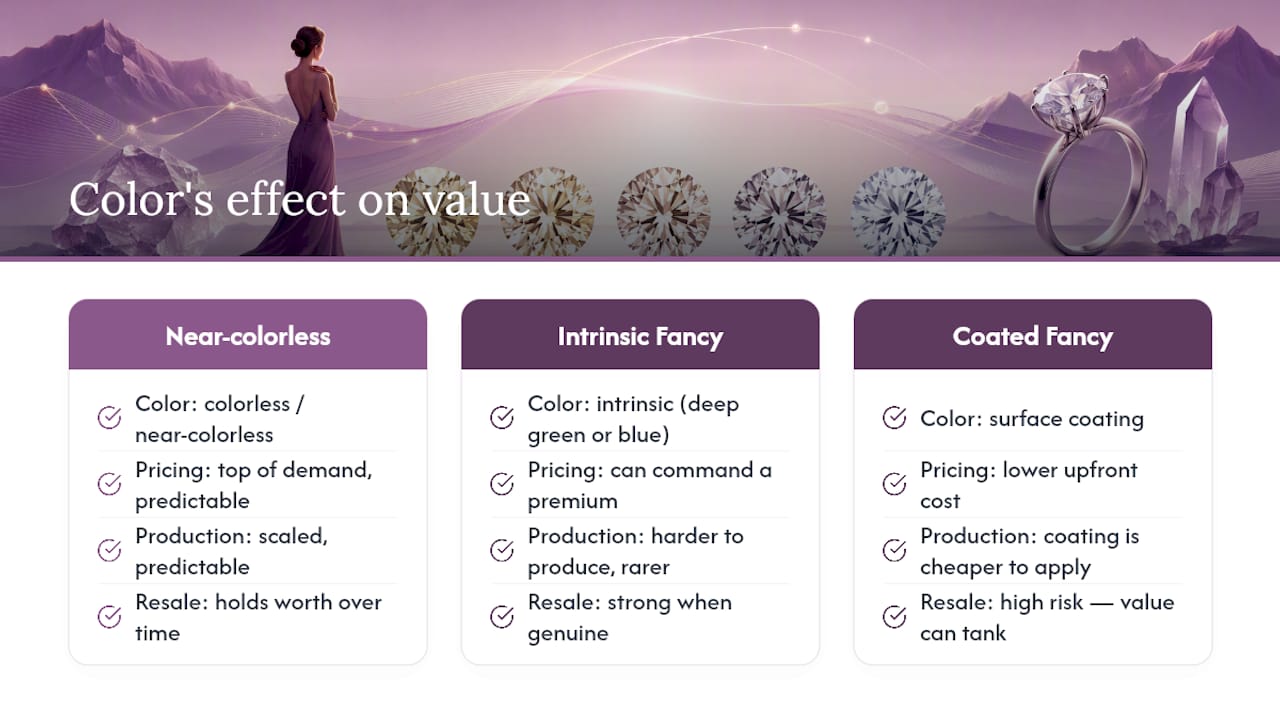
Coated fancy colors sit at the opposite end. They’re usually priced lower going in, precisely because a coating is cheaper to apply than growing color into the crystal itself, and that lower upfront cost comes with a real resale downside: a scratched or faded coating can tank a stone’s value fast, and buyers further down the chain are increasingly aware of that risk.
How Do You Spot a Coated or Treated Moissanite?
You don’t need a lab to catch most red flags. A few careful checks at home or at the counter go a long way.
Start with lighting. View the stone in plain daylight, then again under warm incandescent light indoors. Real color stays consistent across both; a coating can look slightly different or patchy depending on the source. Next, pull out a 10x jeweler’s loupe and examine the pavilion, the pointed facets underneath the stone. Coated stones sometimes show a faint metallic lustre there, or minor scuffing where the coating has started wearing thin at the facet edges, according to the Gemmological Association of Australia’s findings.
Statistic Callout: Researchers at the Gemmological Association of Australia specifically documented metallic lustre on the pavilion facets of surface-coated moissanite, along with visible coating loss at facet edges from ordinary wear, a detail most casual buyers never think to check.
- Look for doubled reflections when viewing through the top of the stone; moissanite’s strong birefringence causes this and helps confirm what you’re actually holding, though it says nothing about color origin.
- Request explicit written disclosure of any treatment, not just a certificate that mimics a diamond report’s format without mentioning coatings.
- When a stone’s color history is unclear, ask for a recognized gem lab check, or simply buy from a seller with a genuine return and warranty policy so you’re covered either way.
How Meri Jaan Applies This Knowledge
At Meri Jaan, every colored moissanite listing states plainly whether a stone’s tone is intrinsic or achieved through treatment, because that distinction is exactly what this guide is built around. Buyers in the Swiss market can generally expect a high-quality near-colorless 1 ct lab-grown moissanite to run $350 to $600, a useful benchmark when comparing quotes elsewhere. Ethical sourcing and sustainability sit at the center of how these stones get made, a point covered in more depth in this look at why moissanite fits sustainable jewelry. Every purchase carries a lifetime warranty, and club members get unlimited exchanges, so a color choice that doesn’t quite land in person isn’t a permanent commitment.

Is Coated Moissanite Worth the Risk?
Colorless and warm intrinsic tones remain the smarter long-term buy for anyone who wants a stone that looks the same at year ten as it did on day one. Coated fancy colors earn their popularity honestly, though. They’re genuinely beautiful, and current design trends are pulling more buyers toward bold, unconventional colors than I’d have predicted five years ago. My advice hasn’t changed: buy the trend if it speaks to you, just buy it from someone who tells you exactly what you’re getting and stands behind it with a real warranty.
— Ammar
Ready to Choose Your Moissanite Color?
Big-box jewelers will sell you a colorless stone and call the conversation done. Meri Jaan’s collections go further, covering the full range from classic colorless pieces to warmer champagne tones and specialty stones, with every listing stating plainly whether a color is intrinsic or treated so you’re never guessing.

Every piece ships with a lifetime warranty, and club members get unlimited exchanges if a color doesn’t read the way you expected once it’s on your hand under real light. That last part matters more than most buyers realize: a stone that looks perfect in a product photo can shift entirely under your bathroom light or your office fluorescents, which is exactly why we recommend trying it on before you commit to a coated fancy color you can’t easily return. If you’re weighing metal and color together, our vintage ring collection shows how champagne and warm tones play against gold settings, and browsing the full ring and jewelry catalog is the fastest way to compare colorless, warm, and specialty stones side by side. Not sure which shade fits your setting or your skin tone? Reach out through the site for a personalized recommendation before you check out.
Sources
Verify these claims yourself through the Gemmological Association of Australia’s coated moissanite alert, the Gem Society’s moissanite overview, and the Wikipedia entry on moissanite.
- Surface-Coated Synthetic Moissanite Now Widely Available - Gemmological Association of Australia
- Moissanite jewelry and gemstone information - Gem Society
- A moissanite color table guide - Tianyu Gems
FAQ
Is Moissanite Valuable?
Moissanite carries real market value, though it’s priced well below diamond of comparable size, with near-colorless 1 ct stones in Switzerland typically running $350 to $600. Colorless and intrinsically colored stones hold their value better than surface-coated fancy colors, which lose worth faster if the coating wears.
Is Moissanite Better Than Diamond?
Neither stone is objectively “better,” they simply serve different priorities. Moissanite offers more fire and brilliance per dollar and comes from a controlled lab-grown process, while diamond carries higher resale recognition and a longer track record as a store of value.
Which Is Better, Moissanite or Cubic Zirconia?
Moissanite outperforms cubic zirconia in nearly every practical way that matters for daily wear. It’s significantly harder, so it resists scratching far better, and its refractive properties give it noticeably more sparkle and fire than cubic zirconia typically shows.
What Colors Does Moissanite Come In?
Moissanite spans colorless and near-colorless, warm champagne and brown tones, and fancy colors including green, blue, gray, black, and pink or red. Many of the brightest fancy colors, especially vivid pinks and multi-hue “aurora” stones, come from surface coatings rather than the stone’s natural composition.
How Can You Tell If a Moissanite Is Coated?
Check the stone under both daylight and warm indoor light for consistency, and use a 10x loupe to look for metallic sheen or wear on the pavilion facets. Always ask the seller directly whether a color is intrinsic or treated, and favor sellers who disclose this openly and back it with a real warranty.

