
Conflict-free fine jewelry refers to pieces guaranteed not to finance armed conflict, but the term alone does not ensure full ethical sourcing or sustainability. The standard industry term is “Kimberley Process certified,” established by the Kimberley Process Certification Scheme (KPCS) in 2003. Examples of conflict-free fine jewelry range from lab-grown diamond cluster engagement rings to recycled 14K gold charm necklaces, and understanding what separates a legal baseline from a genuine ethical commitment helps you shop with real confidence. Merijaan builds its entire collection around lab-grown moissanite, placing it firmly in this category from the start.
1. Examples of conflict-free fine jewelry: lab-grown diamond rings
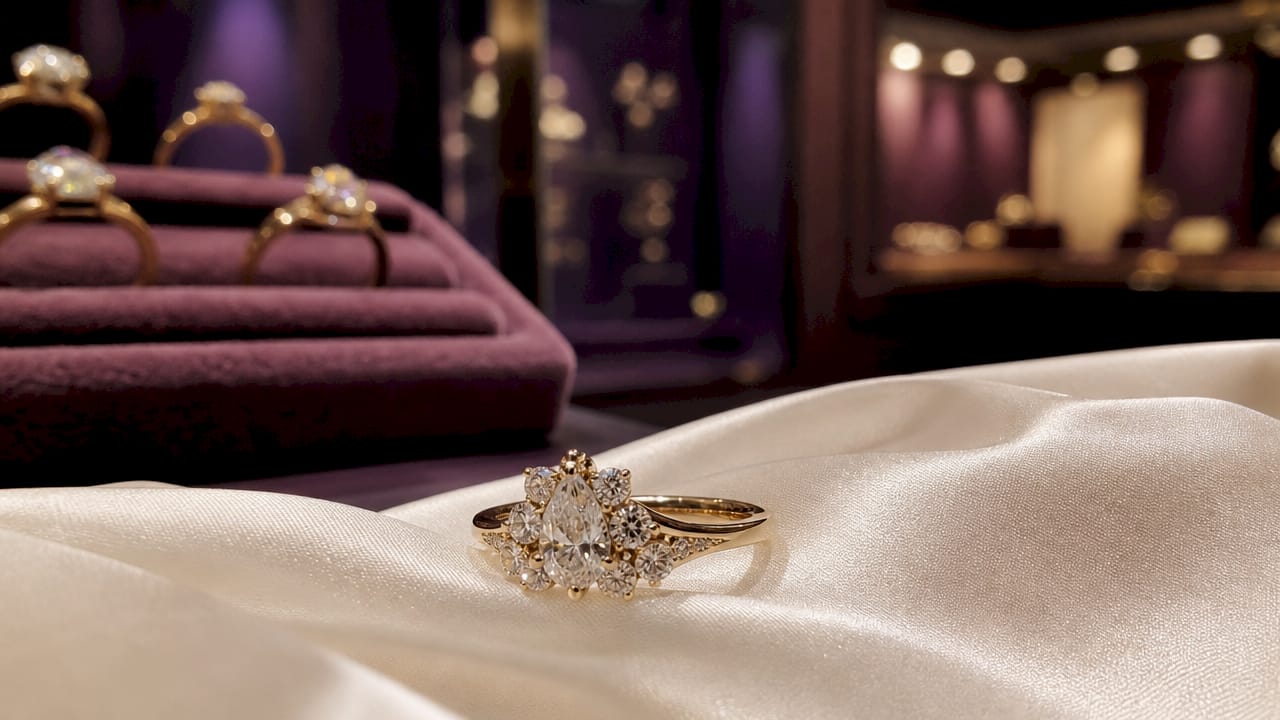
Lab-grown diamond cluster engagement rings are among the most recognizable examples of conflict-free fine jewelry available today. These rings typically feature center stones between 0.80–1.20 TCW, with pavé halo accents adding roughly 0.25 TCW of additional sparkle. Because lab-grown diamonds are manufactured in controlled environments, the Kimberley Process does not even apply to them. That makes the conflict-free label for lab-grown stones technically redundant, but it also means they carry zero risk of financing conflict.
Settings range from 10K to 18K gold, with 14K being the most common choice for balancing durability and purity. A pavé halo design in 14K white gold with a round lab-grown center stone is the style you will see most often in ethical jewelry collections right now.
2. Recycled gold solitaire charms with lab-grown diamonds
Recycled 14K gold solitaire charms set with lab-grown diamonds represent a complete ethical package. The gold has already been refined, so no new mining is required. The lab-grown stone adds zero conflict risk. Together, they address both the sourcing and the environmental sides of ethical jewelry in one piece.
These charms typically feature small oval or round lab-grown diamonds in a bezel or prong setting. They work as standalone pendants or as part of a layered necklace look. Merijaan’s lab diamond pendant follows exactly this approach, pairing a lab-grown stone with a fine silver setting.
3. Lab-grown sapphire, emerald, and ruby necklaces
Colored gemstone necklaces using lab-grown sapphires, emeralds, and rubies in 14K gold settings are a growing category of sustainable fine jewelry. Lab-grown colored stones carry the same physical and chemical properties as mined stones. They also sidestep the complex and often opaque supply chains that make mined colored gemstones difficult to verify.
A lab-grown blue sapphire set in a 14K yellow gold bezel necklace is a strong example of top conflict-free gemstone jewelry styles. The color is vivid, the sourcing is traceable, and the price is significantly lower than a mined equivalent of the same quality. Merijaan’s Baden Necklace showcases this kind of fine craftsmanship with ethical materials.
Pro Tip: When shopping for colored stone jewelry, ask specifically whether the stone is lab-grown or mined. “Natural” does not mean ethical, and “conflict-free” applies legally only to diamonds, not to sapphires or rubies.
4. Moissanite fine jewelry
Moissanite is a lab-created gemstone that produces more brilliance than a diamond on the refractive index scale. It is entirely conflict-free by nature, since it is grown in a laboratory with no mining involved. Merijaan specializes in lab-grown moissanite, making every piece in its collection an example of ethical jewelry by default.
Moissanite works beautifully in rings, necklaces, and bracelets. The Morcote ring from Merijaan features a green teal moissanite halo in 925 sterling silver, combining striking color with fully traceable sourcing. For buyers who want to buy conflict-free rings without any sourcing ambiguity, moissanite is the clearest available choice.
5. Conflict-free vs. ethical jewelry: what the difference actually means
Conflict-free legally refers only to rough diamonds not used to fund armed rebel movements. The Kimberley Process Certification Scheme, established in 2003, is the legal standard. It does not cover labor rights, environmental impact, or fair wages.
“Conflict-free certification does not guarantee fair labor or environmental standards. Many diamonds certified as conflict-free under the Kimberley Process still originate from mines with poor labor and environmental records.”
Third-party audits from organizations like the Responsible Jewellery Council (RJC) validate broader ethical standards beyond Kimberley Process compliance. The table below shows the key distinctions clearly.
| Standard | What it covers | What it misses |
|---|---|---|
| Kimberley Process (KPCS) | Rough diamonds not funding rebel conflicts | Labor rights, environment, wages |
| Responsible Jewellery Council (RJC) | Labor, environment, human rights, business ethics | Not all brands participate |
| Fairmined / Fairtrade Gold | Artisanal miner wages and community impact | Applies only to gold, not gemstones |
| Lab-grown certification | Zero mining impact, traceable origin | Does not address workshop labor conditions |
Lab-grown stones bypass the Kimberley Process entirely, since the process applies only to mined rough diamonds. That makes “conflict-free” a redundant label for lab-grown, but it does not automatically mean the brand’s labor practices are ethical.
6. How to identify truly ethical jewelry when shopping
Sourcing transparency down to the mine or lab level is the clearest signal of a genuinely ethical brand. Brands that publish detailed audit reports and community impact disclosures are operating at a higher standard than those that simply claim “conflict-free.”
Use this checklist when evaluating any jewelry brand:
- Ask for Kimberley Process documentation on any mined diamond, as a legal baseline.
- Look for RJC, Fairmined, or Fairtrade certification as evidence of broader ethical standards.
- Request country-of-origin traceability for both stones and metals.
- Check for third-party audit reports covering labor and environmental practices.
- Verify lab-grown claims by asking for the growth method (CVD or HPHT) and the certifying gemological lab.
- Flag vague language like “responsibly sourced” or “ethically mined” with no supporting documentation as a red flag.
Labels vary widely. Some brands use “conflict-free” solely as a baseline, while others document a full responsibility framework. The difference between those two positions is significant.
Pro Tip: Search a brand’s website for terms like “supply chain,” “audit,” or “traceability.” If those words do not appear anywhere, treat that as a warning sign.
7. Sustainable fine jewelry: pairing conflict-free stones with recycled metals
True ethical jewelry combines conflict-free stones with recycled gold and fair labor practices. Recycled gold requires no new mining, which reduces both environmental damage and the social risks associated with artisanal gold mining. Designers who pair lab-grown diamonds or ethically sourced Montana sapphires with recycled 10K–18K gold settings represent the current best practice in sustainable fine jewelry.
Montana sapphires are a strong example of an ethically sourced mined gemstone. They come from American mines with documented labor standards and environmental oversight. Pairing a Montana sapphire with recycled white gold creates a piece that is traceable from stone to setting.
The key sustainability practices in fine jewelry today break down as follows:
- Recycled metals: Recycled 14K or 18K gold eliminates new mining while maintaining full metal quality.
- Lab-grown stones: CVD and HPHT lab-grown diamonds and colored stones carry zero conflict risk.
- Ethical mined alternatives: Montana sapphires and Fairmined gold represent the best of responsibly mined materials.
- Transparent craftsmanship: Brands that publish workshop conditions and pay data complete the ethical picture.
Merijaan’s Lax Necklace exemplifies this approach, combining fine lab-grown stones with quality metalwork and a commitment to returning 100% of profits to the people who make the jewelry.
8. Where to find conflict-free jewelry you can actually trust
Where you buy matters as much as what you buy. Brands that specialize in lab-grown stones and recycled metals are the most reliable starting point for conflict-free fine jewelry. Look for brands that name their stone suppliers, disclose their metal sourcing, and publish their ethical commitments publicly.
Supply chain opacity is a red flag. Ethical brands publish detailed audits and community impact reports. If a brand’s “ethics” page is a single paragraph with no specifics, keep looking.
Merijaan’s ethics blog covers sustainable jewelry trends and sourcing practices in detail, giving buyers the context they need to evaluate any purchase. The brand’s focus on lab-grown moissanite means every piece sidesteps the sourcing ambiguity that affects mined stone jewelry entirely.
Key takeaways
Conflict-free fine jewelry requires both Kimberley Process compliance and broader ethical verification, with lab-grown stones and recycled metals offering the most traceable and trustworthy options available in 2026.
| Point | Details |
|---|---|
| Conflict-free is a legal baseline | The Kimberley Process covers only rough diamonds funding rebel conflicts, not labor or environment. |
| Lab-grown stones are inherently conflict-free | They are manufactured above ground with no mining, making sourcing ambiguity irrelevant. |
| Ethical jewelry goes further | RJC, Fairmined, and Fairtrade certifications address wages, environment, and supply chain transparency. |
| Transparency is the key signal | Brands that publish audit reports and origin traceability are operating at a genuinely higher standard. |
| Recycled metals complete the picture | Pairing lab-grown stones with recycled gold eliminates the two largest ethical risks in fine jewelry. |
Why I think “conflict-free” is the wrong place to stop
I have spent years watching buyers feel reassured by the words “conflict-free” on a product page, and I understand why. It sounds definitive. It sounds like someone checked. But the Kimberley Process was designed in 2003 to address one specific crisis: diamonds funding rebel armies in West Africa. It was never designed to be a full ethical audit.
The brands I trust most are the ones that treat conflict-free as a floor, not a ceiling. They go further. They name their suppliers. They publish labor audits. They explain exactly where their gold comes from and who refined it. That level of detail is not common, but it exists, and it is the standard worth holding every brand to.
My honest recommendation is to start with lab-grown stones and recycled metals. Not because they are perfect, but because they remove the two biggest sourcing risks immediately. From there, look at the brand’s transparency. Does it publish real information, or does it use vague language that sounds good but says nothing? That question separates the genuinely ethical brands from the ones that are simply marketing to conscious buyers.
Merijaan’s model of returning 100% of profits to its makers is the kind of concrete commitment that actually means something. It is specific, verifiable, and goes well beyond a conflict-free label.
— Ammar
Ethical conflict-free jewelry from Merijaan
Merijaan’s collection puts the principles in this article into practice. Every piece features lab-grown moissanite, which is inherently conflict-free and fully traceable. The brand’s commitment to returning 100% of profits to its jewelry makers addresses the labor side of ethical sourcing that most brands ignore entirely.
The Saint-Moritz Necklace is a strong starting point for buyers who want a fine jewelry piece that meets both conflict-free and broader ethical standards. For bracelets, the Crans-Montana Bracelet combines elegant design with the same ethical sourcing principles. Browse the full collection to find the piece that fits your values and your style.
FAQ
What is conflict-free jewelry?
Conflict-free jewelry refers to pieces made with diamonds certified under the Kimberley Process Certification Scheme, meaning the stones did not fund armed rebel movements. The term applies legally only to mined rough diamonds, not to lab-grown stones or other gemstones.
Are lab-grown diamonds automatically conflict-free?
Yes. Lab-grown diamonds are manufactured in controlled environments with no mining, so the Kimberley Process does not apply to them at all. They carry zero risk of financing conflict by definition.
What is the difference between conflict-free and ethical jewelry?
Conflict-free covers only the diamond funding question under the Kimberley Process. Ethical jewelry goes further, addressing fair wages, safe labor conditions, environmental impact, and full supply chain transparency, often verified by organizations like the Responsible Jewellery Council.
How do I know if a jewelry brand is truly ethical?
Look for brands that publish third-party audit reports, name their stone and metal suppliers, and hold certifications from the RJC, Fairmined, or Fairtrade programs. Vague sourcing claims with no supporting documentation are a reliable red flag.
Is moissanite a conflict-free gemstone?
Moissanite is lab-created and carries no conflict risk. It is one of the clearest examples of a conflict-free gemstone available, with fully traceable origins and no mining impact whatsoever.

