

Jewelry is defined as a tangible language through which people communicate identity, values, and emotions without speaking a word. The role of jewelry in self-expression goes far beyond decoration. Psychologists call this “enclothed cognition,” the proven effect where wearing meaningful objects actively shifts your mindset, posture, and confidence. 80% of American adults purchase fine jewelry for themselves, with millennials reaching 86%, most often as acts of self-empowerment or to mark personal achievements. That number tells a clear story: Americans treat jewelry as a personal statement, not just an accessory.
How does jewelry reflect personality and personal values?
Jewelry choices reveal personality with surprising accuracy. Minimalist jewelry correlates with values of simplicity and restraint, while bold statement pieces align with high confidence, creativity, and a desire for social recognition. A person who wears a single delicate chain every day is communicating something fundamentally different from someone who stacks chunky rings on every finger. Neither is wrong. Both are intentional.
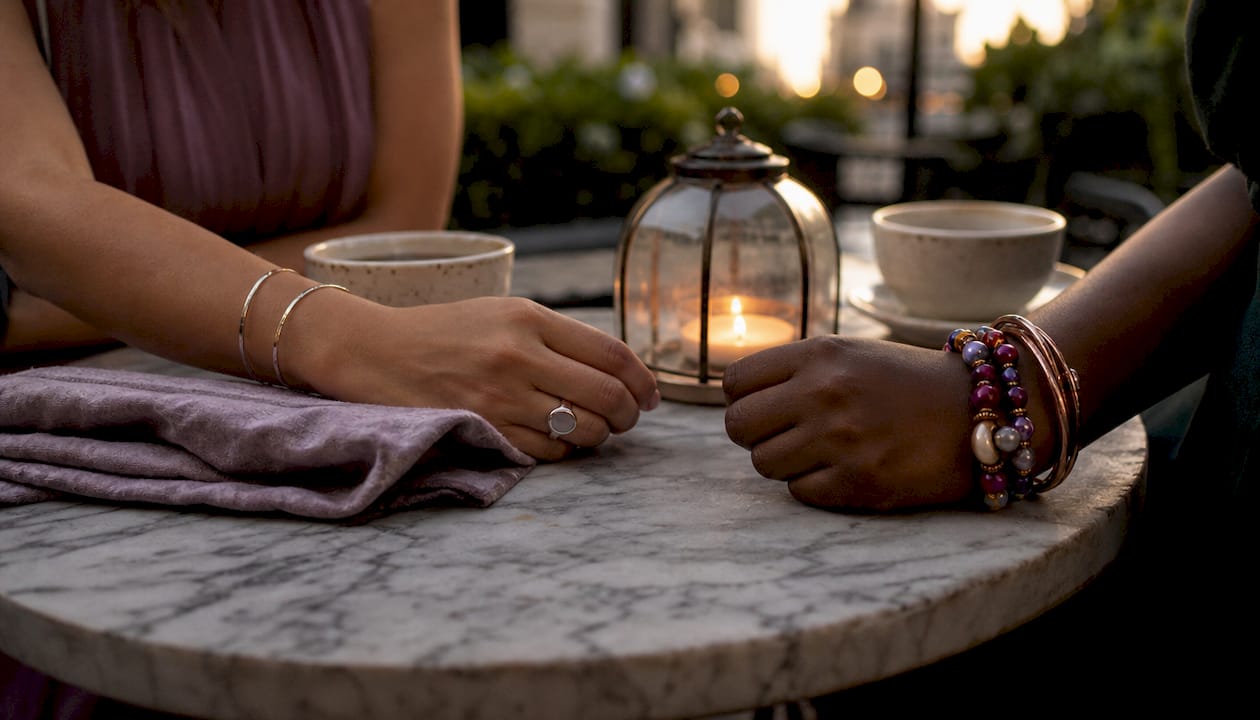
Material choice carries equal weight. Ethically sourced or lab-grown stones have to become a direct expression of environmental and ethical values. Choosing a lab-grown moissanite piece is not just a budget decision. It signals that you care about where your jewelry comes from and what its production costs the planet. Merijaan builds its entire collection on this principle, using lab-grown moissanite so that every piece carries both beauty and a clear ethical position.
Jewelry also functions as social signaling, a way to align your visible self with your personal brand. A professional who wears a clean, geometric pendant to every client meeting is reinforcing a message of precision and taste. Someone who layers vintage brooches is broadcasting creativity and individuality. The pieces you choose become part of how others read you before you speak.
- Minimalist pieces (thin bands, small studs, single pendants) signal restraint, focus, and quiet confidence.
- Bold statement jewelry (oversized hoops, layered chains, sculptural rings) signals creativity, social energy, and self-assurance.
- Ethically sourced materials signal environmental awareness and values-driven purchasing.
- Heirloom or vintage pieces signal connection to history, family, and continuity.
Pro Tip: When building a signature jewelry style, start with one piece that reflects a core value, not a trend. That anchor piece will outlast every seasonal collection.
What is the cultural and historical role of jewelry in identity?
Jewelry has marked identity across every known human culture for thousands of years. The function has shifted, but the impulse has not.
| Era | Primary Function | Example |
|---|---|---|
| Ancient civilizations | Signal bloodline and social rank | Egyptian gold collars worn by royalty |
| Medieval Europe | Denote religious faith and guild membership | Cross pendants, signet rings |
| Victorian era | Communicate mourning and romantic devotion | Mourning brooches containing hair |
| Modern America | Celebrate personal milestones and individual narrative | Self-purchased rings to mark achievements |
Historical jewelry signaled status and lineage, while modern American jewelry focuses on personal milestones and individual storytelling. That shift is significant. Jewelry used to tell others who you were in the social hierarchy. Now it tells the world who you have chosen to become. The role of jewelry in American culture has become deeply democratic, available to anyone who wants to mark a moment or express a belief.
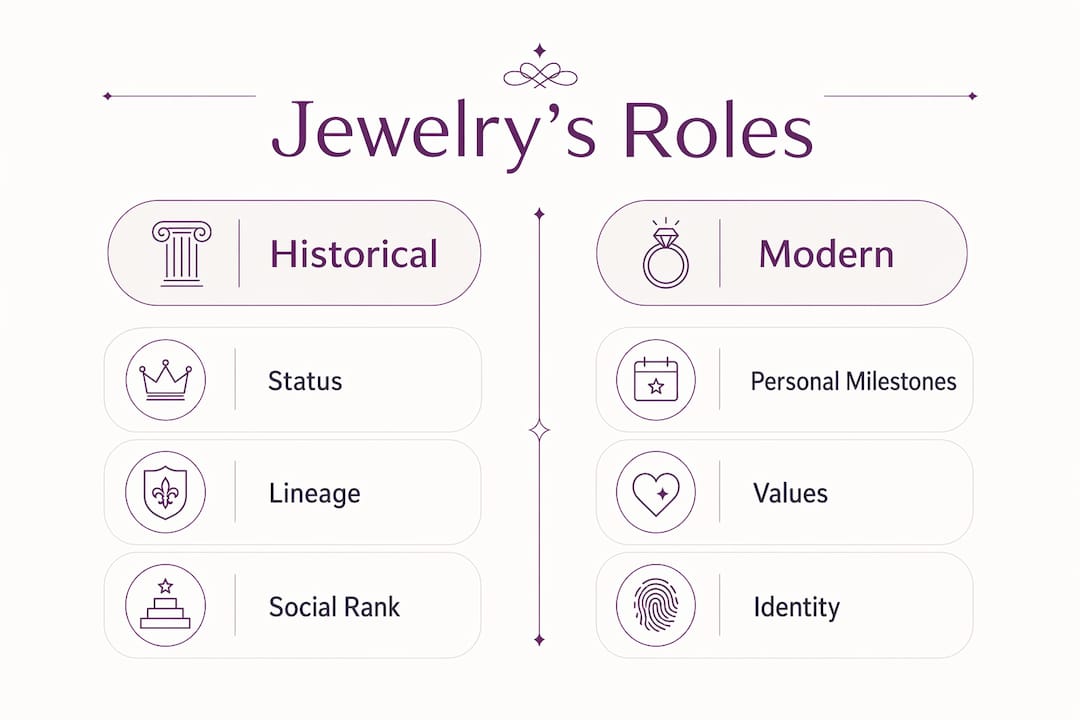
Jewelry marks identity, love, memory, faith, and belonging, with symbolic pieces offering emotional permanence that fashion trends cannot provide. A ring worn to celebrate finishing graduate school carries a meaning no trend can replicate. A necklace gifted by a grandmother holds a story that a mass-produced piece never will. These objects become memory carriers, physical proof that something mattered.
Modern American jewelry also invites rich storytelling in social contexts. When someone asks about a piece you wear, you get to share a piece of your life. That exchange builds connection in a way that most conversations do not.
Why does meaningful jewelry affect your confidence and mood?
Wearing jewelry with personal significance does more than look good. It changes how you feel and how you carry yourself.
Enclothed cognition explains why wearing meaningful jewelry improves confidence, posture, and mood by activating brain reward centers. The effect is not placebo. Brain imaging studies show measurable changes in psychological state when people wear objects they associate with strength, love, or achievement. Put on the necklace your mother gave you before a hard meeting, and your brain responds differently than if you wore nothing at all.
“Jewelry with emotional significance boosts wearer confidence significantly more than purely aesthetic pieces. The meaning embedded in an object changes the psychological experience of wearing it.”
Jewelry acts as emotional anchoring, stabilizing identity through signature pieces that function as grounding devices amid constant change. Life shifts constantly. Jobs change, relationships evolve, and circumstances move. A piece of jewelry you have worn for years becomes a fixed point in that movement. It reminds you of who you are when everything else feels uncertain.
Studies show that jewelry with emotional significance boosts wearer confidence significantly more than purely aesthetic pieces. This is why the role of jewelry in self-care routines matters. Putting on a meaningful piece in the morning is not vanity. It is a deliberate act of self-reinforcement.
How do you build a jewelry style that genuinely expresses who you are?
Building a personal jewelry style takes intention, not just taste. The goal is a collection that reflects your actual values and life, not just what looked good in a store.
-
Start with meaning, not aesthetics. Before buying any piece, ask what it represents. A three-stone necklace can represent past, present, and future. A simple pendant can mark a specific achievement. Meaning gives a piece staying power that pure aesthetics never will.
-
Anchor to a signature piece. Choose one piece you wear almost every day. This becomes your non-verbal baseline, the thing people associate with you. It should reflect something core to your identity, not something trendy.
-
Let milestones drive purchases. Jewelry in everyday life is chosen not just for style but as a ritual that sets a tone for identity and purpose daily. Mark the moments that matter: a promotion, a personal goal reached, a relationship deepened. These pieces build a wearable autobiography over time.
-
Balance subtlety and visibility. Not every piece needs to announce itself. A delicate diamond drop necklace worn close to the skin can carry enormous personal meaning while remaining invisible to most people. Visibility is a choice, not a requirement.
-
Revisit and edit. Your jewelry style should evolve as you do. Pieces that no longer reflect who you are can be retired, gifted, or repurposed. A collection that grows with you is more powerful than one frozen at a single moment in time.
Pro Tip: When selecting jewelry that reflects your professional brand, choose one piece that you wear consistently in work settings. Repetition builds recognition, and recognition builds trust.
The fashion jewelry market reached USD 168 billion globally in 2024, far exceeding the USD 49.1 billion luxury sector. That gap shows that people are choosing expressive, accessible pieces over traditional status symbols. Personal meaning has overtaken prestige as the primary driver of jewelry purchases.
Key Takeaways
Jewelry is a proven psychological and cultural tool for self-expression, with meaningful pieces delivering measurable confidence benefits that purely aesthetic choices cannot match.
| Point | Details |
|---|---|
| Jewelry communicates identity | Your style, material choices, and signature pieces send clear non-verbal signals about your values and personality. |
| Meaning amplifies confidence | Enclothed cognition shows that emotionally significant jewelry actively improves posture, mood, and self-assurance. |
| Cultural roots run deep | Jewelry has marked identity across every culture and era, shifting from status signals to personal milestone markers. |
| Ethical materials are a statement | Choosing lab-grown or ethically sourced stones expresses environmental and moral values, not just aesthetic preference. |
| Build with intention | A signature jewelry style built around meaning and milestones outlasts any trend-driven collection. |
Jewelry has always been the most personal thing you can wear
I have spent years watching people interact with jewelry, and the pattern that strikes me most is how rarely people can explain why a particular piece matters to them. They just know it does. That instinct is not irrational. It is the enclothed cognition effect working exactly as it should.
What I find underappreciated is how jewelry functions as a daily self-care ritual, not just a fashion choice. The person who puts on the same bracelet every morning before work is not being repetitive. They are grounding themselves. They are saying, “This is who I am today, and I am ready.” That small act carries real psychological weight.
The other thing I believe strongly: the most powerful jewelry is rarely the most expensive. A piece of Merijaan moissanite jewelry can carry the same emotional charge as a piece that costs ten times more, because the charge comes from the meaning you assign it, not the price tag. Ethical sourcing adds another layer. When you know the piece was made responsibly, wearing it feels cleaner. There is no quiet discomfort about where it came from.
My honest advice is to stop buying jewelry because it is on trend and start buying it because it marks something real. Your collection should read like a timeline of who you have been and who you are becoming. That is the kind of jewelry that stays with you for life.
— Ammar
Merijaan: jewelry designed to carry your story
Every piece in the Merijaan collection is built around one idea: jewelry should mean something. Merijaan uses lab-grown moissanite to create pieces that are ethically sourced, visually stunning, and priced so that meaning does not require a compromise.
The Saint-Moritz Necklace is designed for moments worth marking, clean lines and brilliant sparkle that wear equally well on a Tuesday morning or a milestone evening. The Lax Necklace offers a subtler expression, a piece that carries personal weight without announcing itself. The Crans-Montana Bracelet is built for everyday wear, a grounding piece you reach for without thinking. Every purchase at Merijaan returns 100% of profits directly to the artisans who craft each piece.
FAQ
What is the role of jewelry in self-expression?
Jewelry serves as a non-verbal language that communicates identity, values, and emotions through style, material, and symbolic meaning. Psychologists describe this as symbolic self-extension, where objects become part of how wearers define and present themselves.
How does jewelry reflect personal values?
Material choices like lab-grown stones signal ethical and environmental values, while style choices like minimalist or bold pieces reflect personality traits such as restraint or confidence. The pieces you wear consistently become a visible expression of what you prioritize.
Why does wearing meaningful jewelry boost confidence?
Enclothed cognition shows that wearing objects with personal significance activates brain reward centers, improving posture, mood, and self-assurance. Studies confirm that emotionally significant jewelry delivers greater confidence benefits than purely aesthetic pieces.
What is the role of jewelry in American culture?
American jewelry culture has shifted from signaling social status to celebrating personal milestones and individual narratives. Self-purchasing is now the norm, with 80% of American adults buying fine jewelry for themselves as acts of empowerment.
How do I build a signature jewelry style?
Start with one piece that reflects a core value or marks a meaningful moment, then build around it with pieces tied to milestones and daily rituals. A signature style evolves with you and carries more personal weight than a trend-driven collection.

