
Artisan jewelry craftsmanship is defined as the skilled, human-led creation of jewelry where the maker personally directs critical decisions at every stage, from shaping metal to setting stones. This practice stands apart from factory production because human judgment drives each piece’s final form, not automated tolerances. The industry term for this practice is “bench jewelry making,” and it covers techniques like forging, soldering, and hand polishing that no machine replicates with the same intentionality. Understanding what defines artisan jewelry helps you spend money wisely, support ethical makers, and recognize genuine quality when you see it.
What is artisan jewelry craftsmanship, and how does it differ from handmade?
The terms “artisan,” “handmade,” and “handcrafted” are not interchangeable, and the legal difference matters. Under FTC §23.2, “handmade” has a specific legal definition: the piece must be manually fabricated from raw materials without significant machine involvement. “Artisan” and “handcrafted,” by contrast, carry no legal definition in US law. They signal skilled involvement but do not specify how much hand labor was personally performed by the maker.
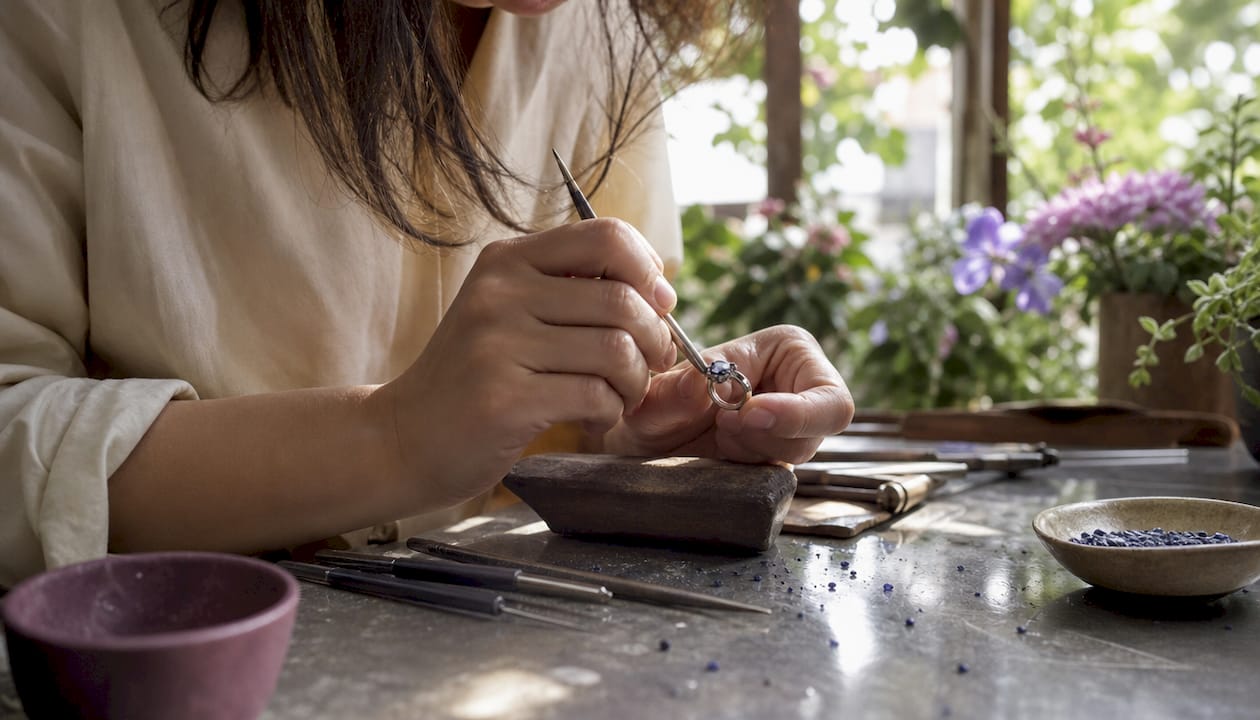
This gap creates real confusion for buyers. A brand can legally call a piece “artisan” even if it was cast in a mold and only hand-finished at the end. That does not make it fraudulent, but it does mean the label alone tells you very little. The FTC Jewelry Guides do not mention “artisan” as a defined term at all, so the label is essentially self-defined by whoever uses it.
Genuine artisan jewelry sits in a different category from mass production. Mass-produced pieces rely on automated casting, machine polishing, and standardized stone sizes that fit pre-cut settings. Artisan work involves the maker’s hand at the stages that matter most: shaping, fitting, setting, and finishing. Some artisan pieces do use molds or casting, but the artisan’s personal decisions about metal thickness, stone placement, and surface texture remain central to the outcome.
Here is what separates artisan jewelry from mass-produced alternatives:
- Maker involvement: An artisan personally performs or supervises each critical step, not a production line.
- Material responsiveness: Artisans adjust their technique based on how a specific metal or stone behaves, something automated systems cannot do.
- Custom settings: Artisan work accommodates non-calibrated or antique stones that standard machine settings cannot hold securely.
- Finishing judgment: A piece is complete when the maker approves it, not when a machine measures it against a tolerance.
- Unique variation: Small differences between pieces are intentional marks of making, not defects.
Pro Tip: When evaluating a piece labeled “artisan,” ask the seller which specific steps the maker performed by hand. A genuine artisan can describe their bench process in detail.
What artisan jewelry techniques does the creation process involve?
The artisan jewelry creation process follows a 10-step lifecycle from concept to packaging, and each step demands a different technical skill. This is not a linear factory workflow. The maker revisits earlier stages when a stone behaves unexpectedly or a solder joint needs correction. That flexibility is exactly what separates bench work from automated production.
The core artisan jewelry techniques include sawing, forging, soldering, stone setting, and polishing. Sawing cuts sheet metal or wire to shape. Forging uses hammers and stakes to shape metal without removing material, which preserves structural integrity. Soldering joins metal components using heat and a filler alloy, requiring precise temperature control to avoid damaging surrounding work. Stone setting, widely considered the most demanding skill, involves securing a gemstone so it sits level, stable, and visually centered. Polishing removes surface scratches and brings out the metal’s natural luster through progressively finer abrasives.
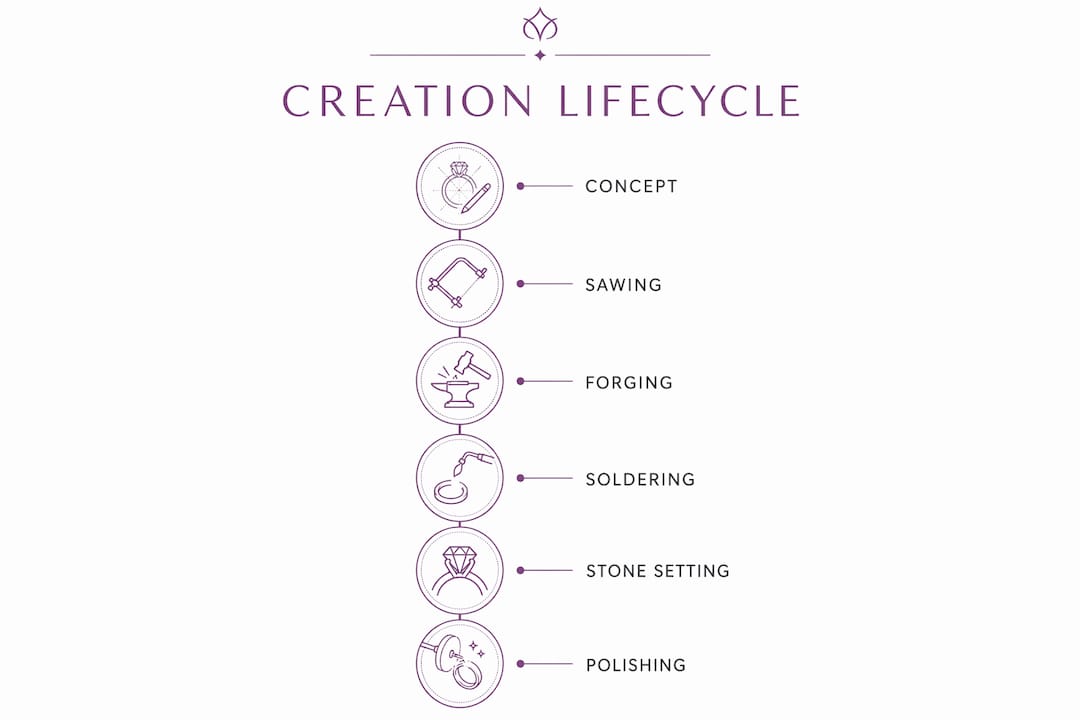
| Step | Description |
|---|---|
| 1. Concept | Sketch or CAD design establishes proportions, materials, and stone placement. |
| 2. Material selection | The maker chooses metal gauge, alloy, and gemstone based on design needs. |
| 3. Shaping | Sawing, forging, or rolling forms the metal into its base structure. |
| 4. Assembly | Components are joined using solder or mechanical connections. |
| 5. Stone setting | Gemstones are secured by hand using gravers, bezel pushers, or prong tools. |
| 6. Refining | Files and abrasive papers remove tool marks and smooth transitions. |
| 7. Texturing | Hammering, engraving, or sandblasting adds surface character. |
| 8. Polishing | Progressively finer compounds bring the metal to its final finish. |
| 9. Inspection | The maker personally examines every surface, joint, and setting for quality. |
| 10. Packaging | The finished piece is cleaned and presented in a way that protects it. |
Modern artisans do use tools like flex shafts, ultrasonic cleaners, and laser welders. These tools speed up repetitive tasks but do not replace the maker’s judgment at critical points. A laser welder still requires the artisan to position the piece correctly and decide where the weld goes. The time investment per artisan piece far exceeds factory production speed, which is why handcrafted jewelry carries a higher price and a longer wait.
Pro Tip: Ask your jeweler how long a specific piece takes to make from scratch. Genuine artisan work typically requires several hours of bench time per piece, not minutes.
What makes artisan jewelry unique and valuable to consumers?
Artisan jewelry carries value that mass production structurally cannot replicate. The most visible quality is intentional variation. Each piece reflects the individual artisan’s decisions, skill level, and material responsiveness, which means no two pieces are truly identical even when made from the same design. These variations are called “marks of making,” and they give each piece character rather than inconsistency.
The practical value shows up most clearly in stone setting. Artisan bench jewelers can work with non-calibrated, antique, or irregularly shaped gemstones that standard machine settings cannot accommodate. A custom bezel or prong arrangement tailored to a specific stone’s proportions holds it more securely and displays it more beautifully than a generic pre-cut setting. This matters especially for buyers who want to use heirloom stones or unusual cuts. You can learn more about how setting style shapes price when working with artisan makers.
Ethical sourcing is another defining characteristic of artisanal jewelry. Small-scale artisan workshops typically source materials from known suppliers, use recycled metals, and maintain direct relationships with gem dealers. This transparency is harder to achieve at factory scale. For buyers who care about ethical jewelry production, artisan makers offer a clearer chain of custody from raw material to finished piece.
“Artisan craftsmanship synthesizes artistic vision with technical skill, and the variations in pieces tell stories rather than indicating mistakes. The maker’s hand is present in every surface, every joint, and every decision about how a stone sits in its setting.”
The emotional value of artisan jewelry is real and measurable in how people wear and keep it. Buyers who know the story behind a piece, who made it, what tools were used, and what decisions shaped it, tend to treat it as an heirloom rather than a fashion accessory. That connection between maker and wearer is something no automated production line can manufacture.
How to identify authentic artisan jewelry craftsmanship when buying
Identifying genuine artisan work requires asking specific questions, not reading labels. The artisan label carries no legal standard in major markets, so the burden falls on the buyer to investigate the maker’s actual process. A transparent artisan will welcome these questions. A seller who cannot answer them is a warning sign.
Use this process when evaluating a piece:
- Ask which steps the maker performed personally. A genuine artisan can name specific techniques: “I forged this shank, set the stone by hand, and finished the surface with a burnisher.” Vague answers like “it’s all handmade” without specifics deserve follow-up.
- Look at the stone setting closely. Stone setting quality is the clearest indicator of artisan skill. The stone should sit level, with prongs or bezels that grip evenly and show no tool damage on the surrounding metal.
- Check for a maker’s mark. Many artisans stamp their work with a personal hallmark or studio mark. This is not legally required in the US, but its presence signals professional accountability.
- Ask about the production method. Some artisan pieces use wax molds for casting, which is legitimate. Molded pieces can still be artisan work if the maker hand-finishes, sets stones, and inspects each one personally. The question is what happens after the cast comes out of the mold.
- Request process photos or a studio visit. Authentic artisans document their work. Photos of bench setups, tools, and work in progress confirm that a real maker is behind the piece.
Pro Tip: Avoid resetting stones yourself if a prong loosens. Stone setting adjustments require specialized tools and bench jeweler expertise. Attempting it at home risks cracking the stone or collapsing the setting.
The most common pitfall buyers face is treating “artisan” as a quality guarantee. It is a starting point for investigation, not a conclusion. Brands that use the term broadly in marketing without offering process transparency are not necessarily dishonest, but they are asking you to take their word for it. Genuine artisans earn the label through verifiable practice.
Key Takeaways
Artisan jewelry craftsmanship is defined by the maker’s direct involvement in critical decisions at every stage, making each piece structurally and aesthetically distinct from mass-produced alternatives.
| Point | Details |
|---|---|
| Legal definitions matter | “Handmade” has FTC legal standing; “artisan” and “handcrafted” do not, so investigate the maker’s process directly. |
| Ten-step creation process | Genuine artisan work follows a lifecycle from concept to inspection, with the maker’s hand present at each stage. |
| Custom settings add real value | Artisans fit settings to individual stones, improving security and appearance beyond what standard molds allow. |
| Marks of making signal quality | Small variations between artisan pieces are intentional and desirable, not manufacturing errors. |
| Ask specific process questions | Transparent artisans describe their bench techniques in detail; vague answers warrant further scrutiny. |
Why craftsmanship is the part of jewelry most buyers overlook
Most buyers focus on the stone or the metal when they evaluate jewelry. I understand why. Those are the visible, quantifiable elements. But after years of watching people choose pieces and then return to ask why a prong failed or why a setting looks off after six months, I am convinced that craftsmanship is the variable that determines everything else.
The skill gap between a trained bench jeweler and someone who learned from a kit is enormous, and it shows up in places buyers rarely check before purchasing. The way solder flows through a joint, the angle at which a prong is pushed over a stone, the sequence of abrasives used in polishing. These decisions are invisible in the finished piece but determine how long it lasts and how it ages.
What I find most underappreciated is the inspection step. A finished piece is only complete when the maker personally examines it and decides it is wearable. That human judgment cannot be replicated by a quality control camera or a tolerance measurement. It is the maker asking: “Would I wear this? Would I give this to someone I care about?” That question is the final quality filter, and it only exists in artisan work.
Consumers are also getting better at recognizing the difference, which is encouraging. The growing interest in ethical jewelry production reflects a broader shift toward understanding where things come from and who made them. That shift benefits artisan makers and the buyers who support them.
— Ammar
Artisan craftsmanship at Merijaan: women’s rings worth wearing
Merijaan builds every piece around the same principles this article describes: skilled human involvement, ethical sourcing, and materials chosen for lasting quality. The core collection uses lab-grown moissanite, which delivers exceptional brilliance without the ethical concerns tied to mined stones.

The women’s rings collection at Merijaan reflects genuine attention to setting quality, metal finish, and design proportion. Each ring is crafted to wear well daily, not just look good in a photograph. Merijaan also returns 100% of profits to the people who make the jewelry, which means every purchase directly supports the artisans behind the work. For buyers who want craftsmanship they can verify and ethics they can trust, that is a meaningful distinction.
FAQ
What is the definition of artisan jewelry craftsmanship?
Artisan jewelry craftsmanship is the skilled, human-led creation of jewelry where the maker personally directs critical steps including shaping, stone setting, and finishing. It prioritizes individual craft decisions over automated production methods.
Is “artisan” jewelry legally defined in the US?
No. The FTC Jewelry Guides define “handmade” but do not include “artisan” or “handcrafted” as legal terms. These labels indicate skilled involvement but carry no enforceable production standard.
How do I identify genuine artisan jewelry?
Ask the maker which specific steps they performed by hand, examine stone setting quality closely, and look for a maker’s mark or process documentation. Transparent artisans describe their bench techniques in specific detail.
Can artisan jewelry use molds or casting?
Yes. Some artisan pieces are cast using wax molds, which is a legitimate technique. A piece qualifies as artisan work when the maker hand-finishes, personally sets stones, and inspects each piece after casting.
Why does artisan jewelry cost more than mass-produced pieces?
Artisan pieces require significantly more bench time per unit, use materials selected for individual designs, and involve skilled labor at every critical stage. That time and expertise cannot be compressed to factory speed without eliminating what makes the piece artisan.

