
Jewelry weight is the primary input to melt value. Specifically: Melt Value ≈ weight (g) × purity (decimal) × spot price per gram. To convert the commodity-quoted spot price from troy ounces to grams, divide by 31.1035 (since 1 troy ounce equals 31.1035 grams). A 10-gram 14K gold piece at a spot price of $90 per troy ounce works out to roughly $2.89 per gram, giving a melt value before any buyer deductions. That number is the floor. Craftsmanship, certified stones, brand, and provenance can push the final price well above it. Merijaan’s approach to jewelry design starts from this reality: weight matters, but it never tells the whole story.
Key formula: Melt Value = Weight (g) × Purity (decimal) × (Spot Price per troy oz ÷ 31.1035)
Table of Contents
- How you should measure jewelry weight: units, scales, and accuracy
- How to turn a piece’s weight into money: the melt value formula
- How appraisers, buyers, and insurers treat weight differently
- Why perceived weight can fool you: hollow construction, plating, and density
- How weight affects comfort, durability, and design choices
- When weight is only part of the story: gems, craftsmanship, and provenance
- A step-by-step checklist to estimate metal value before you sell or insure
- Key Takeaways
- Weight, value, and why the formula is only the starting point
- Merijaan can help you understand what your jewelry is really worth
- Useful sources for further reading
How you should measure jewelry weight: units, scales, and accuracy
Grams are the practical unit for shop and home-level weighing. The commodity market quotes gold in troy ounces, and some older jewelers still use pennyweights (dwt), a legacy unit from the apothecary system. Knowing all three prevents confusion when comparing quotes.
| Unit | Where it’s used | Scale precision needed |
|---|---|---|
| Gram (g) | Retail shops, home scales, most appraisers | 0.1 g for pieces >2 g; 0.01 g for lighter items |
| Troy ounce (ozt) | Commodity markets, refiners | N/A — convert from grams |
| Pennyweight (dwt) | Some US jewelers and estate buyers | 0.01 g equivalent |
Scale accuracy matters more than most sellers realize. A 0.1 g rounding error on a 1-gram piece can shift the calculated payout by 10% or more. For anything under about 2 grams, a professional scale reading to 0.01 g is the right call.
Best practices for accurate weighing:
- Calibrate the scale before each session using a certified calibration weight.
- Tare the container or tray before placing the piece.
- Weigh on a stable, vibration-free surface away from air vents.
- Remove detachable stones or attachments when possible to isolate metal weight.
Pro Tip: If you can’t remove a stone, note its approximate carat weight and ask your appraiser to deduct it as stone weight adds to total weight.
How to turn a piece’s weight into money: the melt value formula
Melt value is calculated as weight × purity × spot price per gram and represents the theoretical floor. Here’s how the math works step by step.
Karat-to-decimal conversion:
| Karat | Purity decimal | Gold content |
|---|---|---|
| 18K | 0.750 | 0.750 |
| 14K | 0.583 | 0.583 |
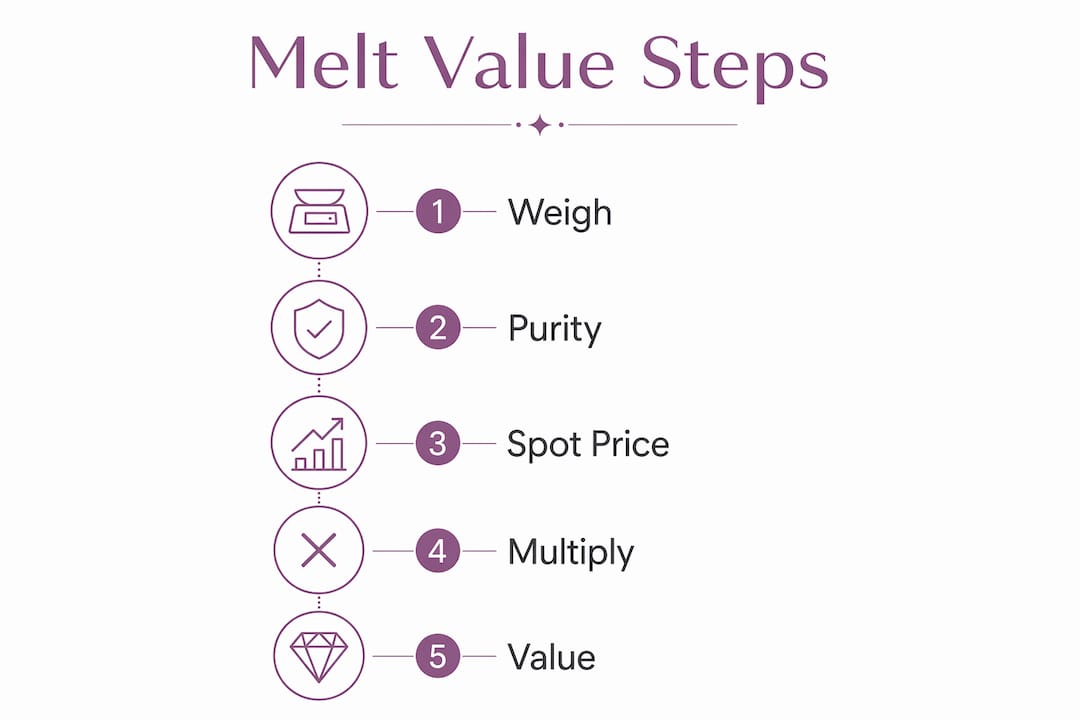
Worked example: You have a 14K gold chain weighing 12 grams. Gold spot is $3,200 per troy ounce. Convert: $3,200 ÷ 31.1035 = $102.88 per gram. Apply purity: $102.88 × 0.583 = $59.98 per gram of pure gold. Multiply by weight: $59.98 × 12 = $719.76 theoretical melt value.
That figure is theoretical. Buyers typically pay a percentage of melt value depending on buyer type, refining costs, and overhead, with some paying less and others approaching melt value.
Melt value is the floor, not the ceiling. A piece with a maker’s mark, certified stones, or documented provenance can sell for multiples of that number through the right channel.
Watch out for these weight traps:
- Stones, clasps, and base-metal springs are not gold. Appraisers and refiners deduct non-gold components before calculating content; sellers who use total weight without this adjustment routinely overestimate payouts.
- Hollow-core pieces look heavy but contain far less metal than their size suggests.
- Gold-plated items have a negligible precious-metal layer over a base-metal core.
How appraisers, buyers, and insurers treat weight differently
Weight means different things depending on who’s evaluating the piece. Understanding that gap can save you from a bad deal.
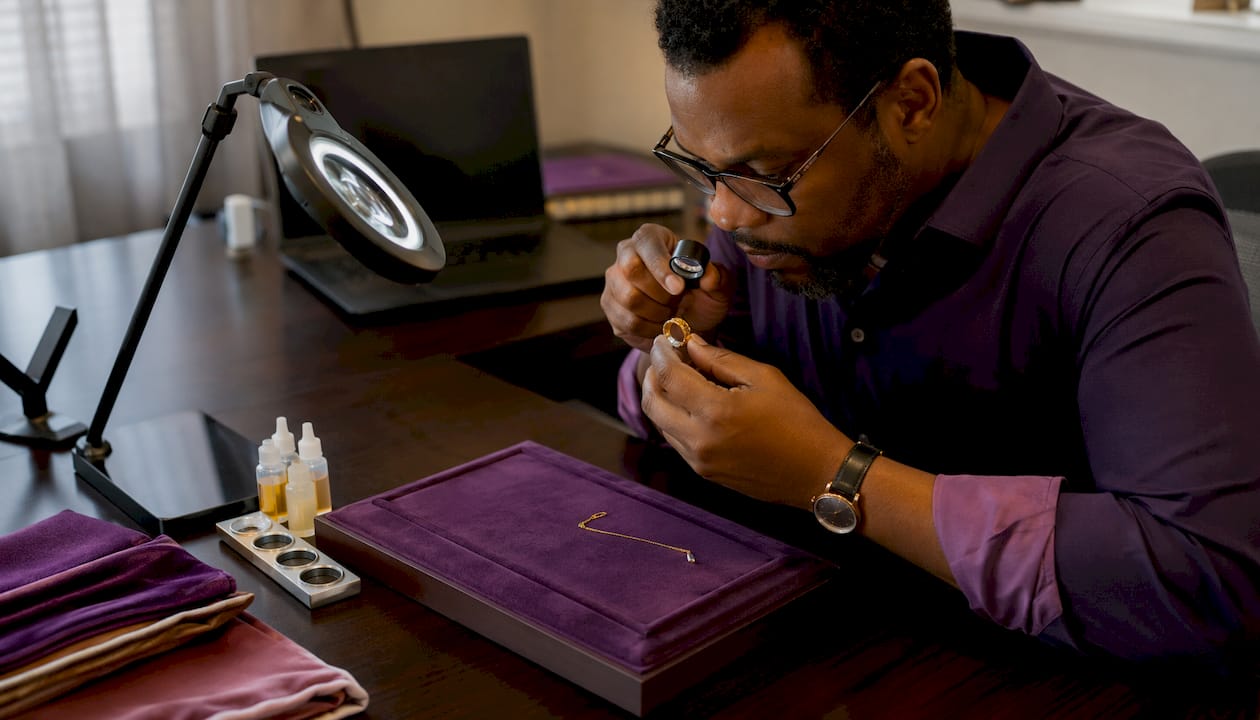
Appraiser: A certified appraiser (look for GIA Graduate Gemologist credentials or an ASA-certified appraiser) calculates replacement cost, which is what it would cost to buy an equivalent piece at retail today. Weight is one input; stone grades, brand, and condition all factor in. This number is typically the highest of the three valuations.
Buyer or refiner: They care about melt value minus their margin. They will weigh the piece, verify karat with an acid test or XRF analyzer, deduct non-metal components, and apply their payout percentage.
Insurer: Insurance replacement value is usually based on the appraiser’s retail replacement figure, not melt value. Insurers want to know what it costs to replace the piece, not what the metal is worth stripped down.
Questions to ask any evaluator:
- “Is this a melt-only quote or a retail replacement appraisal?”
- “How did you verify purity — acid test, XRF, or hallmark only?”
- “What did you deduct for stones and non-metal components?”
- “What percentage of melt value is your offer?”
Documents and marks to bring:
- Original purchase receipt or certificate
- Hallmark photos (stamp location, karat mark, maker’s mark)
- Any previous appraisal reports
- Lab reports for significant gemstones (GIA, AGS)
Why perceived weight can fool you: hollow construction, plating, and density
Consumers frequently equate heft with value, and manufacturers know it. Several techniques create the impression of substantial jewelry while minimizing precious-metal content.
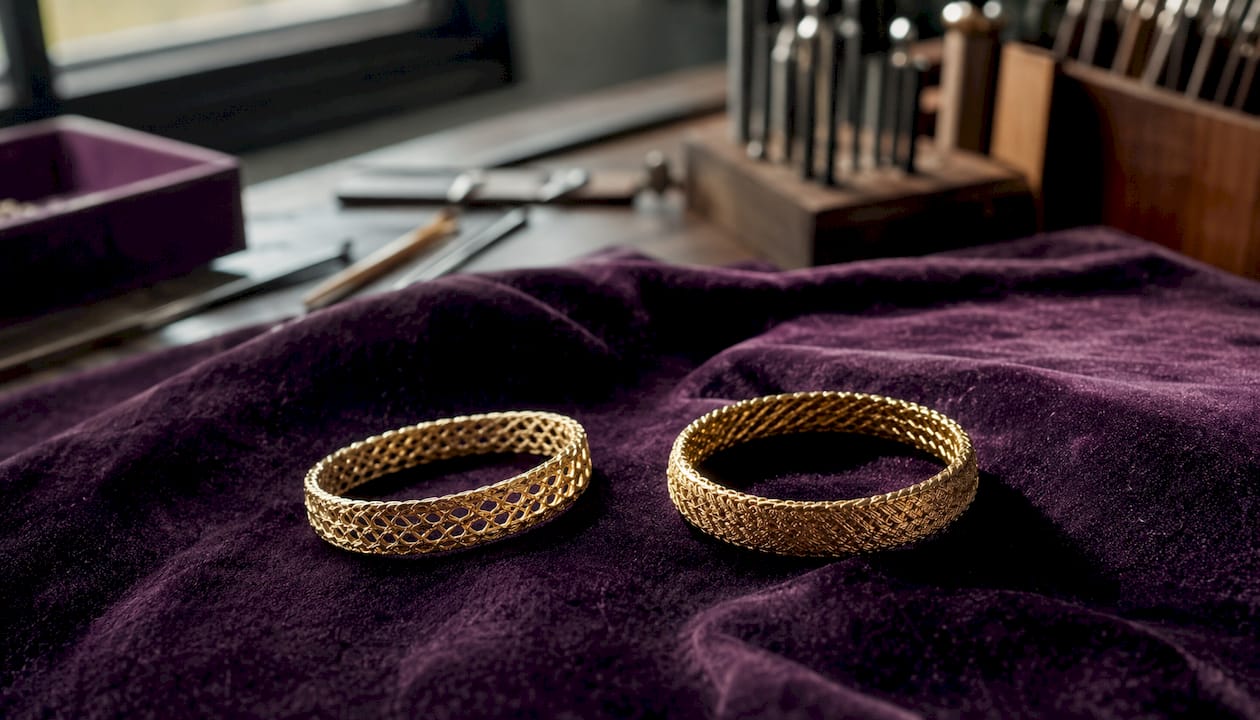
Hollow-core construction is the most common. A hollow-core piece looks substantial but weighs far less than a solid piece of the same size, carries lower melt value, and is more fragile. Repairs on hollow pieces often cost more than the metal is worth.
Gold-filled and rolled gold have a thicker gold layer than plating but still use a base-metal core. The gold layer is typically 5% of total weight by US federal standards, so a 10-gram gold-filled bangle contains roughly 0.5 grams of actual gold.
Heavy base-metal cores with plating feel solid and expensive. The density of brass or copper is close enough to gold that casual handling won’t reveal the difference.
Red flags to check before buying or selling:
- Visible seams along the inside of a tube-style chain or bangle
- Unexpected lightness when you pick up a large piece
- A hollow sound when tapped gently against a hard surface
- Thin walls visible at a cut or worn edge
- “GF,” “GP,” or “RGP” stamps instead of a karat mark
How weight affects comfort, durability, and design choices
Weight is a design parameter, not just a monetary one. Appropriate piece weight contributes to both durability and comfort, particularly for items worn daily.
Practical weight guidelines by piece type:
- Earrings: Light studs cause minimal strain; heavier drop earrings may stretch piercing holes over time.
- Chains: Mid-weight necklaces balance presence with comfort; very heavy statement chains are suited for occasional wear.
- Bangles and cuffs: Solid bangles that are noticeably heavy can feel fatiguing on the wrist during a full workday.
Heavier pieces generally last longer because thicker metal walls resist bending and scratching. But a clasp rated for a 5-gram pendant will fail under a 15-gram one. For durable jewelry for daily wear, the right weight is the one that matches both the clasp strength and the wearer’s comfort threshold.
Hollow pieces solve the weight-comfort problem but introduce fragility. A solid 14K chain at 8 grams will outlast a hollow 14K chain at 4 grams in almost every scenario involving daily wear.
When weight is only part of the story: gems, craftsmanship, and provenance
Melt value is the floor, and for many pieces it’s a low one. Pieces with brand, provenance, or certified stones can command 2×–5× or more over melt value depending on market demand and condition.
Consider a signed Art Deco platinum brooch weighing 8 grams. At current platinum spot prices, the melt value might be $150. At auction, with documented provenance and a period maker’s mark, the same piece could fetch $1,500 or more. The metal weight barely registers in that transaction.
Artisan craftsmanship adds value that no scale can capture: hand-engraving, micro-pavé setting, and period-specific techniques all represent labor and skill that the secondary market prices separately from metal content.
Selling a branded or antique piece for scrap is almost always a mistake. Get a formal appraisal first — the premium above melt can be substantial, and you can’t undo a refiner’s furnace.
Pro Tip: Seek a formal appraisal when a piece has any of the following: a maker’s mark or hallmark from a recognized house, certified stones of significant size, documented age, or original packaging and receipts. The appraisal fee pays for itself quickly if the piece has collector value.
Fair-trade and ethical sourcing also affect perceived value among buyers who care about provenance. A piece with a documented ethical supply chain can command a premium in certain markets, particularly among younger buyers.
A step-by-step checklist to estimate metal value before you sell or insure
This procedural checklist gives you a defensible quick estimate in under 10 minutes.
- Weigh the piece on a calibrated scale. Use 0.01 g precision for anything under 2 grams.
- Locate the hallmark. Check the clasp, inner band, or jump ring for a karat stamp (10K, 14K, 18K, 585, 750).
- Look up the live spot price in USD per troy ounce (use Kitco or the CME Group website).
- Convert spot to per gram: divide the troy-ounce price by 31.1035.
- Apply the purity decimal (14K = 0.583, 18K = 0.750, etc.) to get the value per gram of actual gold.
- Estimate non-metal weight. If the piece has stones or a heavy clasp, subtract an estimated weight for those components.
- Multiply: (adjusted metal weight) × (value per gram of actual gold) = theoretical melt value.
- Apply a realistic buyer discount: 70%–85% is a reasonable working range for most retail buyers; refiners may go higher.
Mini-example: An 18K bracelet weighs 9 grams. Spot price per troy ounce can be converted to per gram, then adjusted for purity and multiplied by weight to estimate melt value. Applying a typical buyer payout percentage gives a realistic payout estimate.
Stop and call a professional if: the piece has stones larger than a few millimeters, carries a maker’s mark from a recognized house, or has unclear or unusual hallmarks. Selling it as scrap when it has collector value is a one-way door.
Key Takeaways
Jewelry weight sets the melt-value floor through the formula Weight × Purity × Spot Price per gram, but craftsmanship, stones, and provenance routinely push the final price well above that baseline.
| Point | Details |
|---|---|
| The melt-value formula | Multiply grams × purity decimal × spot price per gram to get the theoretical floor price. |
| Scale precision matters | Use 0.01 g resolution for pieces under 2 grams; 0.1 g is acceptable for heavier items. |
| Deduct non-metal weight | Stones, clasps, and base-metal parts inflate total weight; always subtract them before calculating gold content. |
| Non-weight factors raise value | Certified stones, maker’s marks, and provenance can substantially increase a piece’s value above melt value. |
| Merijaan’s approach | Merijaan designs for both accurate metal value and wearability, with ethical sourcing built into every piece. |
Weight, value, and why the formula is only the starting point
Most articles on jewelry weight stop at the arithmetic. Weigh it, multiply by purity, multiply by spot price, done. That framing is useful but incomplete, and it leads sellers to two opposite mistakes: overvaluing a hollow gold-plated piece because it feels heavy, or undervaluing a signed vintage brooch by treating it as scrap.
The formula matters. Knowing it protects you from buyers who quote a low number without showing their work. But the more interesting question is always: what raises a piece above melt? The answer is almost never more metal. It’s the maker’s hand, the stone’s certification, the documented history. Those are the things a scale can’t measure.
At Merijaan, the design philosophy reflects this directly. Every piece is built with weight calibrated for comfort and longevity, not just for perceived heft. Lab-grown moissanite is chosen because it delivers genuine optical performance, not because it adds grams. And 100% of profits go back to the artisans who make the work. That’s a value proposition that lives entirely outside the melt-value formula.
If you’re buying, don’t let a heavy feel substitute for a hallmark check. If you’re selling, don’t let a buyer’s quick scale reading be the last word. The floor is calculable. The ceiling depends on what you know about what you have.
Merijaan can help you understand what your jewelry is really worth
Knowing the melt-value formula is a solid start. But if you’re looking at a piece with stones, an unfamiliar hallmark, or a design you suspect has value beyond the metal, the next step is a conversation with someone who understands both the math and the craft.
Merijaan offers guidance on jewelry valuation, design adjustments for wearability, and ethical sourcing for new pieces. Every piece in the collection is built with transparent craftsmanship and materials you can trace. If you’re preparing for an appraisal, considering a repair, or looking for a piece designed to last, explore Merijaan’s collection and see what responsible jewelry design looks like in practice. Reach out directly for a consultation on what your piece might be worth and how to get the most from any appraisal or sale process.
Useful sources for further reading
- How to Determine the Value of Jewelry — Covers the five factors that drive jewelry value, including the melt-value formula and how appraisers handle non-metal components.
- Understanding Measurement Units on Jewelry Scales — Explains grams, troy ounces, and carats with practical guidance on scale precision for different piece weights.
- What Your Gold Is Actually Worth Per Gram — Walks through realistic buyer payout ranges and a step-by-step checklist for estimating gold value before selling.
- Is Heavier Gold Jewelry Always Worth More? — Addresses the hollow-core misconception and explains why heft alone is not a reliable value signal.
- How to Calculate the Weight of Jewelry — Technical breakdown of hollow vs. solid construction and how manufacturing choices affect both weight and repairability.
- How to Calculate Gold and Silver Jewelry Value at Home — Practical home-valuation guide with context on when branded or stone-set pieces exceed melt value by significant multiples.
- Antique Silver — Reference resource for hallmark identification and period maker’s marks on antique silver and gold pieces.
- Antique Jewelry Buyers — Guidance on selling antique and estate jewelry, including how provenance and condition affect offers above melt value.

